Displacement, Distance, Speed and Velocity
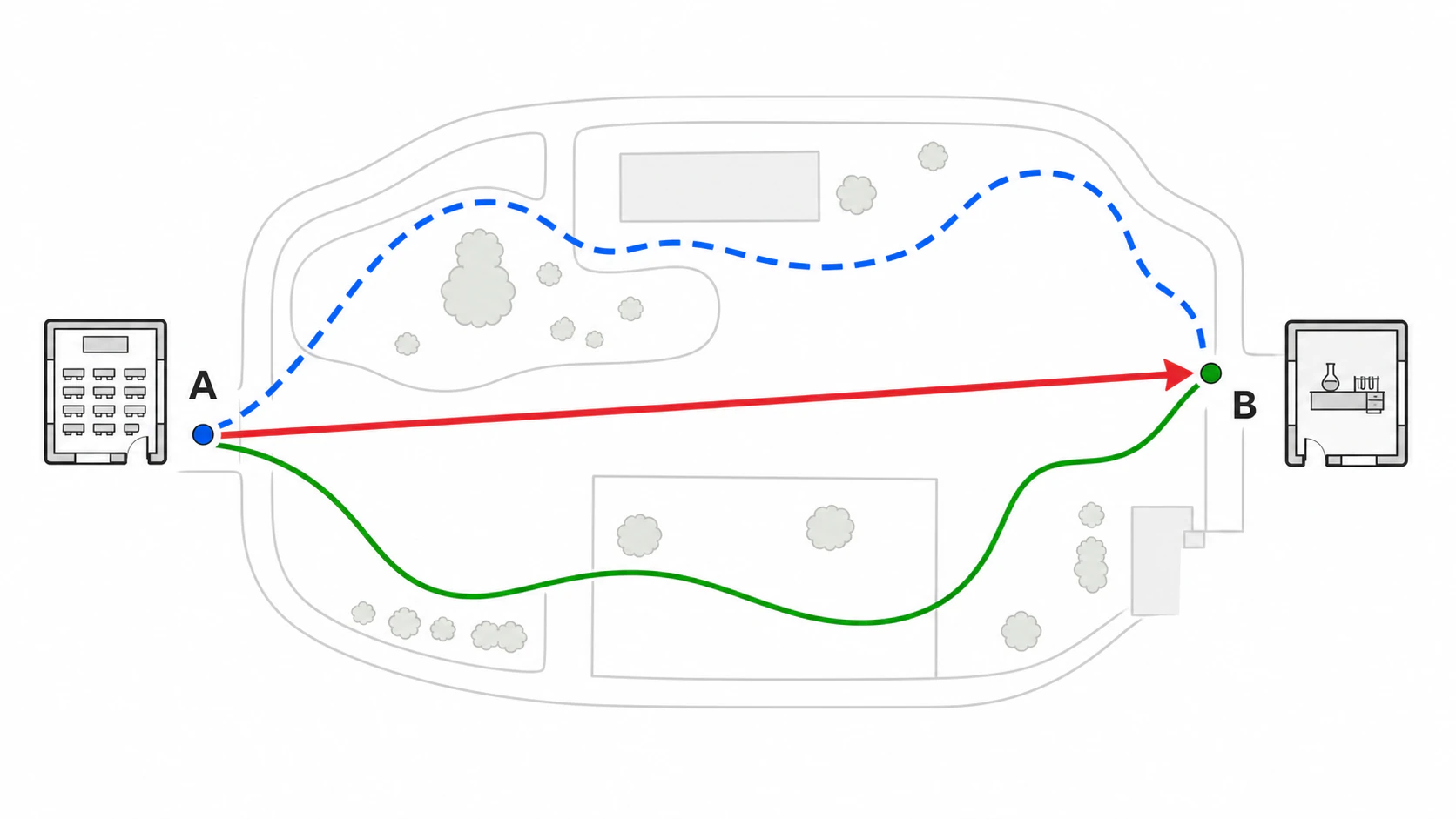
Distinguish distance from displacement and speed from velocity, then use both ideas in constant-velocity models.
Starter | Describe Motion Before Naming It
Before formal definitions are introduced, classify four everyday descriptions of a student's route.
Use these categories once each: distance/path length, change in position with direction, time, and direction of motion/velocity language.
- (a) The student walks 420 m along the route.
- (b) Point B is 260 m east of point A.
- (c) The walk takes 5.0 min.
- (d) The student arrives moving east along the corridor.
Reveal Q1 (1)(1)
distance/path length
The statement gives the length travelled along the route.
Reveal Q1 (2)(2)
change in position with direction
The statement compares two positions and includes a direction.
Reveal Q1 (3)(3)
time
The description is a duration.
Reveal Q1 (4)(4)
direction of motion/velocity language
The statement describes the direction of motion; after teaching, this supports velocity language.
Every Motion Description Needs a Model
Choose first
object, origin, positive direction, clock
Position Locates the Object Relative to an Origin
Checkpoint | Keep One Sign Convention
The same marker is 4.0 m east of an origin. Student A chooses east as positive; Student B chooses west as positive.
The physical location is unchanged when the coordinate convention changes.
- State the coordinate assigned by each student and explain why the signs differ.
Reveal Q1Q1
A: +4.0 m; B: -4.0 m.
East is the positive direction for A, so the eastward point has a positive coordinate. West is positive for B, so east is the negative direction. The signs differ because the axes differ, not because the marker moved.
Distance Adds the Entire Path
Distance
Total path length travelled.
Scalar and non-negative.
A reversal adds distance.
Displacement Uses Initial and Final Position
Q1 | Warehouse Marker Displacements
A warehouse robot reports signed positions along one straight aisle. For each move, calculate the displacement and state whether the motion is towards increasing or decreasing s.
Use Δ s=sf-si.
- (a) si=14 m, sf=31 m.
- (b) si=-9 m, sf=-18 m.
- (c) si=7 m, sf=-11 m.
- (d) si=-24 m, sf=-16 m.
Reveal Q1 (1)(1)
+17 m, towards increasing s.
Δ s=31-14=+17 m.
Reveal Q1 (2)(2)
-9 m, towards decreasing s.
Δ s=-18-(-9)=-9 m.
Reveal Q1 (3)(3)
-18 m, towards decreasing s.
Δ s=-11-7=-18 m.
Reveal Q1 (4)(4)
+8 m, towards increasing s.
Δ s=-16-(-24)=+8 m.
Q2 | Inspection Trolley Turnaround
An autonomous inspection trolley moves along a straight rail from s=15 m to s=24 m, then reverses and stops at s=3 m.
Positive s is fixed along the rail.
- (a) Calculate the displacement.
- (b) Calculate the distance travelled.
- (c) Explain why the two answers are different.
Reveal Q2 (1)(1)
-12 m.
Δ s=3-15=-12 m.
Reveal Q2 (2)(2)
30 m.
Distance =(24-15)+(24-3)=9+21=30 m.
Reveal Q2 (3)(3)
Distance counts the full path; displacement uses only the initial and final positions.
The reversal adds to path length, while displacement remains the net signed change from 15 m to 3 m.
Direction Separates Vectors from Scalars
Scalars
distance, speed, time
Vectors
displacement, velocity
magnitude and direction
Speed Tracks Distance; Velocity Tracks Displacement
Average speed
Average velocity
Average Describes the Whole Interval
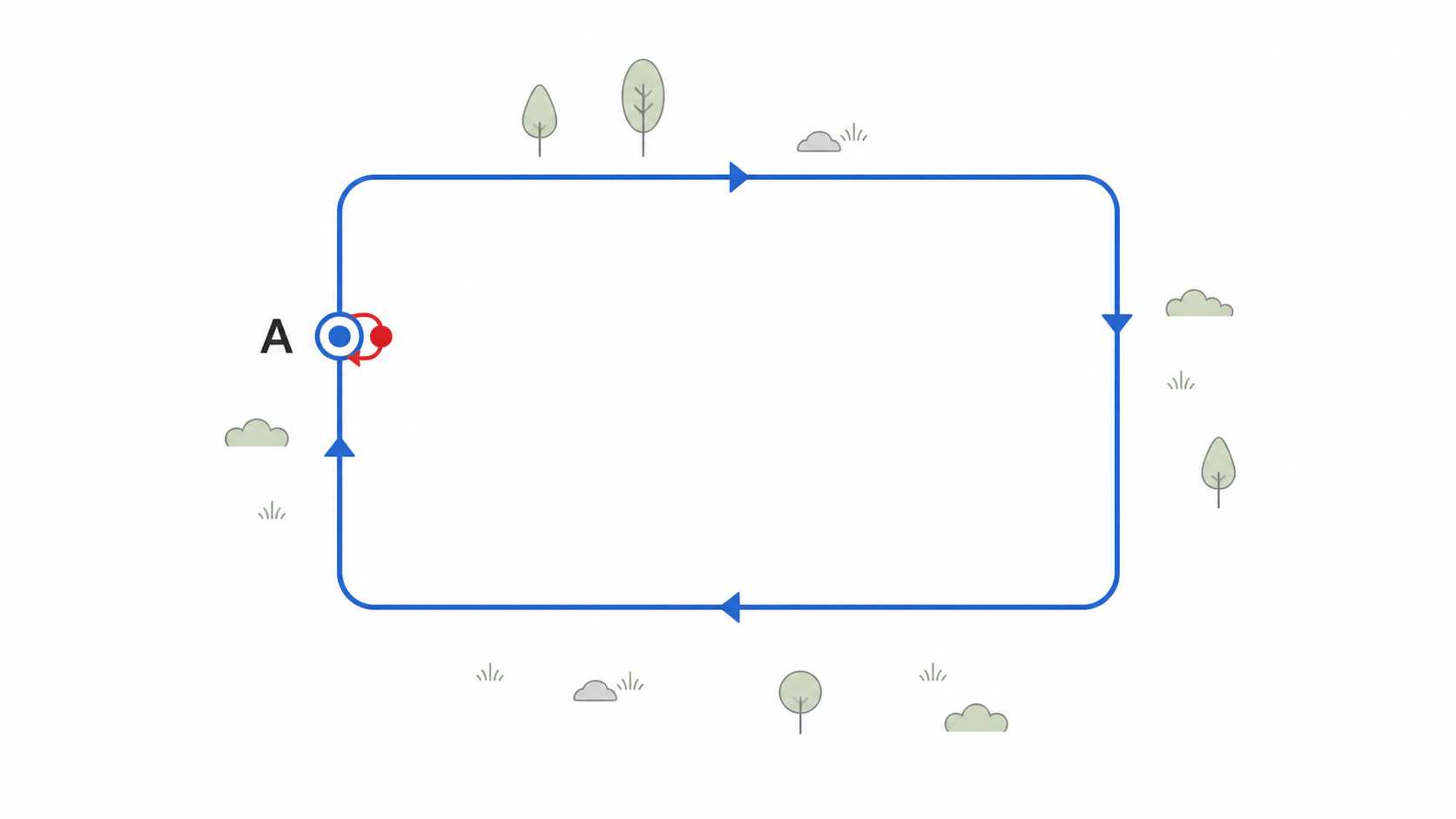
Q3 | Inspection Trolley Average Values
An inspection trolley travels from s=15 m to s=24 m, then back to s=3 m, in a total time of 6.0 s.
Its displacement is -12 m and its total distance is 30 m.
- (a) Calculate the average velocity.
- (b) Calculate the average speed.
- (c) Explain why the average values are not equal.
Reveal Q3 (1)(1)
-2.0 m s-1.
v̄=Δ s/Δ t=-12/6.0=-2.0 m s-1.
Reveal Q3 (2)(2)
5.0 m s-1.
Average speed =30/6.0=5.0 m s-1.
Reveal Q3 (3)(3)
Average speed uses total distance; average velocity uses signed displacement.
The denominators are the same, but reversal makes total path length different from net change in position.
Q4 | Research Boat Round-Trip Average Speed
A research boat travels from a pier to a buoy at 12 m s-1 and returns along the same route at 24 m s-1.
The outward and return distances are equal.
- (a) Explain why the average speed is not 18 m s-1.
- (b) Determine the average speed for the round trip.
Reveal Q4 (1)(1)
The slower outward leg takes longer, so the two speeds are not weighted by equal times.
The arithmetic mean would apply to equal time intervals, not equal distances. More journey time is spent at 12 m s-1.
Reveal Q4 (2)(2)
16 m s-1.
Let one-way distance be d. Then average speed =2d/(d/12+d/24)=16 m s-1.
Uniform Motion Means Constant Velocity
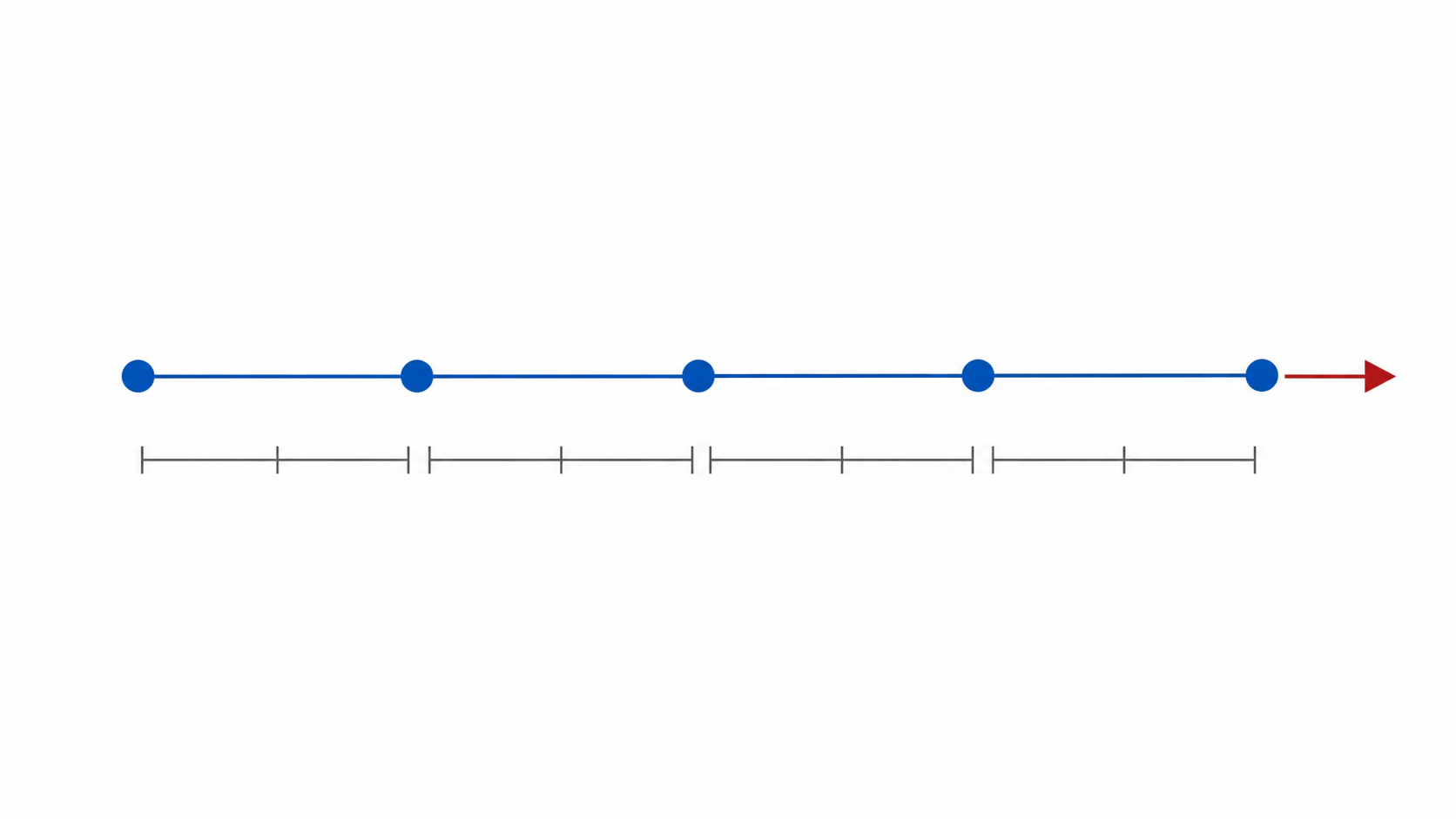
Equal displacements occur in equal time intervals.
A direction change changes velocity.
Constant Velocity Gives a Linear Position Model
Q5 | Constant-Velocity Cart Position
A cart starts at si=-5.0 m and moves with constant velocity +2.0 m s-1 for 8.0 s.
Use the declared signed coordinate.
- (a) Calculate the final position.
- (b) Calculate the displacement.
- (c) State why s=si+vt is valid.
Reveal Q5 (1)(1)
+11 m.
s=si+vt=-5.0+2.0(8.0)=+11 m.
Reveal Q5 (2)(2)
+16 m.
Δ s=sf-si=11-(-5.0)=+16 m, also vt.
Reveal Q5 (3)(3)
The velocity is constant over the interval.
The linear position relation follows from a constant velocity model.
Q6 | Inspection Vehicles Meeting | Setup
Inspection vehicle A starts at s=0 and moves at +24 km h-1. Vehicle B starts at s=168 km and moves at -32 km h-1. They start together.
Use one shared origin and one shared clock.
- (a) Write the position equation for A.
- (b) Write the position equation for B.
Reveal Q6 (1)(1)
sA=24t.
Initial position is zero and velocity is +24, so sA=0+24t.
Reveal Q6 (2)(2)
sB=168-32t.
B begins at 168 km and moves in the negative direction.
Q6 | Inspection Vehicles Meeting | Solve
Inspection vehicle A starts at s=0 and moves at +24 km h-1. Vehicle B starts at s=168 km and moves at -32 km h-1. They start together.
Use the two position equations from the setup.
- (c) Determine when the vehicles meet.
- (d) Determine the meeting position.
- (e) State the displacement of A at the meeting.
- (f) State the displacement of B at the meeting.
Reveal Q6 (3)(3)
3.0 h.
At meeting, 24t=168-32t, so 56t=168 and t=3.0 h.
Reveal Q6 (4)(4)
72 km.
s=24(3.0)=72 km.
Reveal Q6 (5)(5)
+72 km.
Δ sA=72-0=+72 km.
Reveal Q6 (6)(6)
-96 km.
Δ sB=72-168=-96 km.
Gradient and Area Represent Different Quantities
Position-time
Gradient gives velocity.
Velocity-time
Signed area gives displacement.
Q7 | Straight Position-Time Gradient
A straight position-time graph passes through (0,3.0 m) and (6.0 s,21.0 m).
A straight line represents constant velocity.
- Determine the constant velocity.
Reveal Q7Q7
+3.0 m s-1.
The velocity is the gradient: (21.0-3.0)/(6.0-0)=+3.0 m s-1.
Q8 | 2015 Constant Positive Velocity Graph Check
2015-MAY-TZ1-P1-SL-Q4Official-source checkpoint
Official IB Physics examination question; prompt omitted from public delivery.
Source metadata: 2015-MAY-TZ1-P1-SL-Q4
Use the teacher-created reasoning and answer reveal on this public slide.
Reveal Q8Q8
C.
The velocity is initially constant and positive, so displacement increases linearly. Velocity then decreases smoothly to zero while remaining positive, so displacement continues to increase but its gradient falls continuously to zero. Only option C has that shape.
Q9 | 2013 Velocity-Time Area Check
2013-MAY-TZ1-P1-SL-Q3Official-source checkpoint
Official IB Physics examination question; prompt omitted from public delivery.
Source metadata: 2013-MAY-TZ1-P1-SL-Q3
Use the teacher-created reasoning and answer reveal on this public slide.
Reveal Q9Q9
A.
Area under a velocity-time graph has units (m s-1)(s)=m and equals displacement. Therefore the correct option is A.
Exit Ticket | Connect L01 to L02
A shuttle moves along a straight corridor. Take east as positive. From t=0 to 4.0 s, its velocity is +2.0 m s-1. From t=4.0 s to 7.0 s, its velocity is -1.0 m s-1.
The velocity-time representation consists of two horizontal segments: +2.0 m s-1 for 4.0 s, followed by -1.0 m s-1 for 3.0 s.
- (a) Determine the total distance travelled and the displacement during the 7.0 s interval.
- (b) State whether one constant-velocity model is valid for the complete 7.0 s interval.
- (c) Use signed area under the velocity-time representation to determine the displacement.
Reveal Q1 (1)(1)
Distance =11 m; displacement =+5.0 m (east).
The eastward distance is (2.0)(4.0)=8.0 m. The westward distance is (1.0)(3.0)=3.0 m, so total distance is 8.0+3.0=11 m. The signed displacement is +8.0-3.0=+5.0 m.
Reveal Q1 (2)(2)
No.
Velocity changes from +2.0 m s-1 to -1.0 m s-1 at 4.0 s. One constant-velocity model cannot describe both intervals, although each horizontal segment can be modelled separately.
Reveal Q1 (3)(3)
+5.0 m.
Signed area is (+2.0)(4.0)+(-1.0)(3.0)=+8.0-3.0=+5.0 m. The negative rectangle subtracts from displacement but still contributes positively to distance.
Q10 | Delayed Inspection Vehicle Meeting
Vehicle A starts at s=0 and travels at +24 km h-1. Vehicle B starts at s=168 km and travels at -32 km h-1, but B starts 1.0 h after A.
Let t be the time since A started.
- (a) Write an expression for B's position after B has started.
- (b) Determine when the vehicles meet.
- (c) Determine their meeting position.
- (d) Explain why the expression for B is valid only for t≥1.0 h.
Reveal Q10 (1)(1)
sB=168-32(t-1).
B has travelled for t-1 hours, so its negative displacement is -32(t-1).
Reveal Q10 (2)(2)
t=25/7 h=3.57 h.
Solve 24t=168-32(t-1): 56t=200, so t=25/7 h.
Reveal Q10 (3)(3)
s=600/7 km=85.7 km.
s=24(25/7)=600/7=85.7 km.
Reveal Q10 (4)(4)
Before 1.0 h, B has not started moving.
The factor t-1 is B's elapsed travel time and cannot describe motion before release.